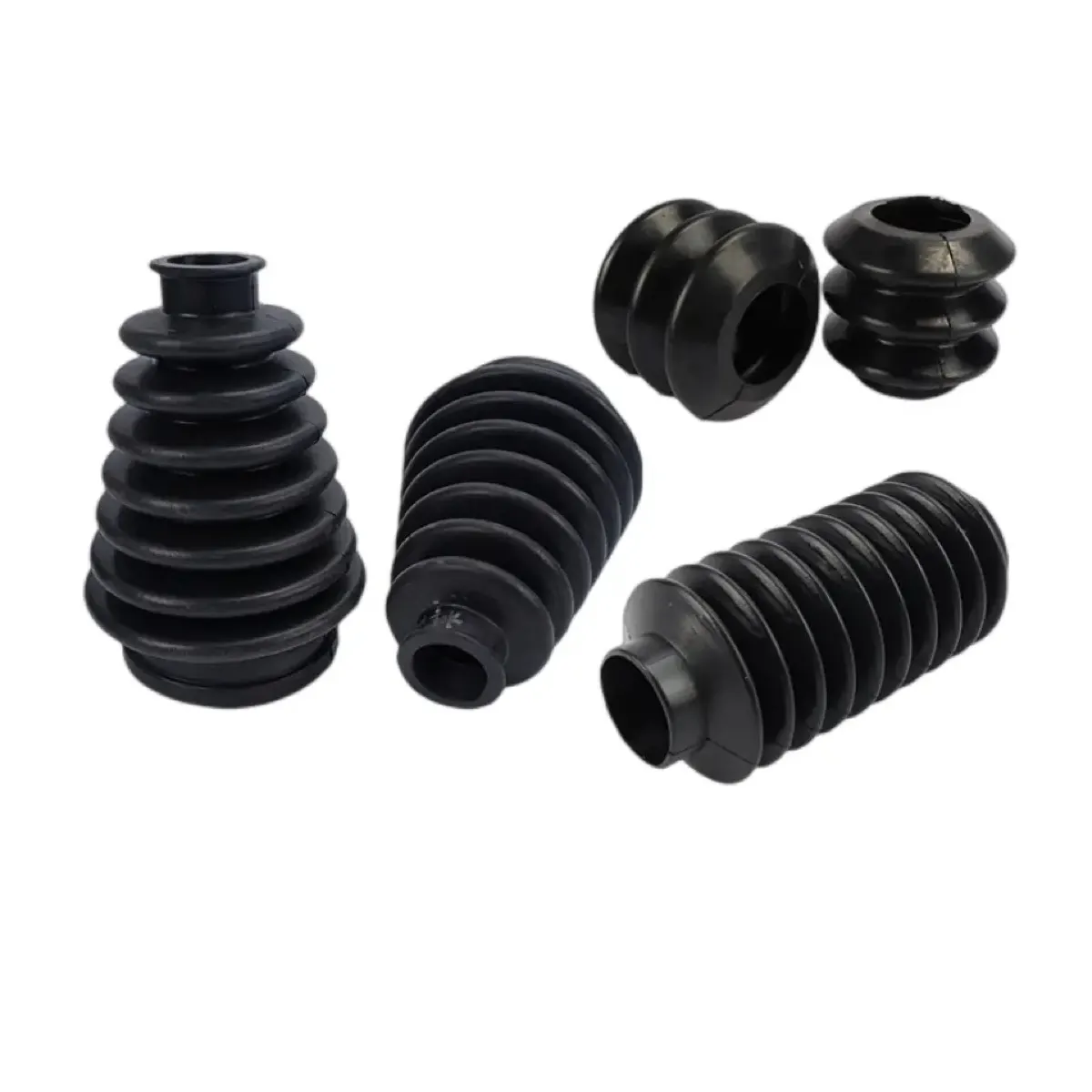
Accordion bellows with many close-spaced convolutions for long stroke in a short installed length — protection for linear guides, ball screws, cylinders and robot axes.
An accordion bellows trades pressure capacity for stroke. Dozens of shallow convolutions let the sleeve collapse to a fraction of its extended length, so a long-travel axis can be covered without a tall stack of rigid guards. That is why accordion geometry dominates machine protection: linear guides, ball screws, cylinders, robot arms and XY tables.
Stroke Versus Length
The useful number is the compression ratio — extended length divided by compressed length. More convolutions raise the ratio but thin the folds, so each fold takes less pressure. In protection duty that trade is fine, because the bellows only has to keep chips, coolant and dust out, not hold pressure.
Two design details decide service life. The fold must not rub against itself when fully compressed, so we set a minimum compressed height per convolution; and the wall must be thick enough to survive clamp pressure at the ends without thinning the first fold.
Where Accordion Bellows Fit
- Linear guides and ball screws on machining centres: chip and coolant exclusion
- Pneumatic and hydraulic cylinders: rod protection in dusty or washdown plants
- Robot axes and gantries: telescoping covers over exposed ways
- Screw conveyors and lifts: dust sealing along the stroke
- Lab and clean equipment: light-duty particle exclusion
Material Choice
NBR holds oil mist and coolant, EPDM takes washdown and outdoor UV, neoprene adds ozone resistance, and silicone covers the hot end at -60°C to 230°C. All compounds are RoHS and REACH compliant.
What to Send for a Quotation
- Cross-section or bore and the extended length
- Stroke, plus the compressed length the machine can give up
- Speed and cycle rate of the axis
- Contaminant: chips, coolant, dust, washdown, weld spatter
- End attachment: clamp collars, zip ties, bolted frames or molded rings
Quotations in 24 hours, tooling quoted in 7 days, samples in 7-12 working days.
FAQ
How do I calculate the compressed length I need?
Take the stroke and divide by the number of convolutions you can fit, then add the minimum fold height. Send both the extended and compressed limits with the drawing; we set the convolution count so the folds never bottom out.
Does an accordion bellows resist oil and coolant?
With NBR, yes — oil mist and water-soluble coolant are its normal service. If the axis also sees hot chips or weld spatter, silicone or a heavier wall is the better call.
Can the cover be opened for maintenance?
Yes. We mold split versions with a closure along the length, or supply a sleeve with an overlapping flap, so the bellows can be fitted around an assembled shaft rather than slid on from the end.