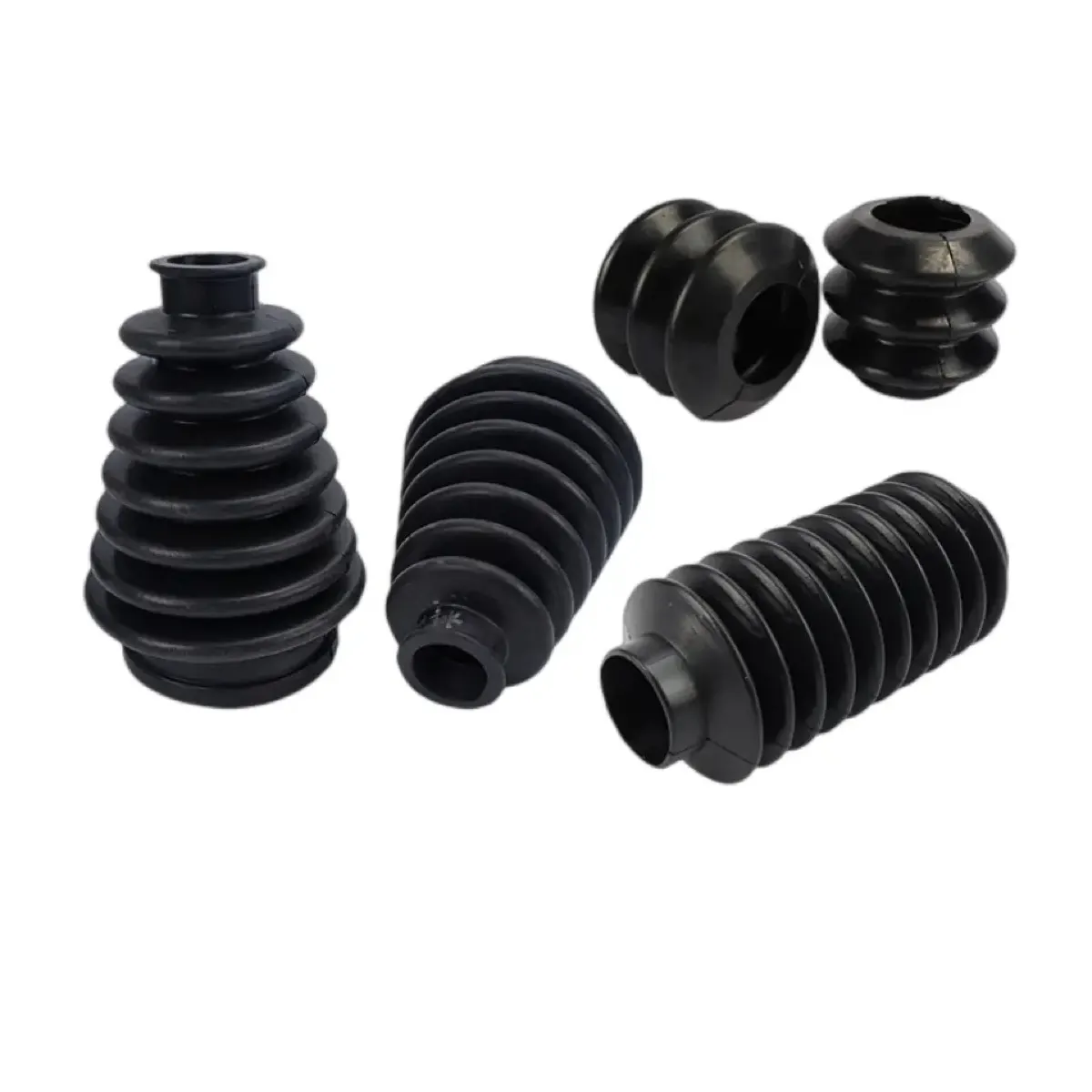
Rubber bellows are molded, convoluted elements that absorb movement in piping and machinery. A typical rubber bellows compensates axial extension and compression of 20% to 50% of nominal length, plus lateral offset and angular deflection, while the seamless elastic wall keeps the media inside and follows the pipe instead of resisting it.
What Are Rubber Bellows?
A rubber bellows is a flexible sealing and movement element with a series of convolutions molded into the wall. The convolutions let the wall fold and unfold, so the bellows behaves like a spring: it extends, compresses, tilts and shifts sideways while staying leak-tight. Plant engineers and equipment builders use them as pipe expansion joints, vibration isolators and protective covers — the same body serves as an expansion joint on pipework or as a cover on moving parts; the geometry changes, the molding method does not.
Compared with welded metal bellows, an integrally molded rubber bellows has no welds and therefore no stress-corrosion risk at the convolution roots. The low elastic reaction force puts little load on pipe supports and equipment nozzles, and the compound itself damps vibration instead of transmitting it — which is why they are standard on pumps, compressors, chillers and HVAC lines.
Custom Rubber Bellows: Materials & Selection
Media, temperature and pressure decide the compound. We mold EPDM, NBR, Neoprene and silicone bellows as standard, and natural rubber for select designs; all compounds are RoHS and REACH compliant, with food-grade and medical-grade silicone available on request.
| Material | Best for | Typical temperature | Watch out for |
|---|
| EPDM | Hot water, steam, weathering | -40°C to 130°C | Oils and fuels |
| NBR | Oils, fuels, hydraulic media | -40°C to 130°C | Ozone and outdoor UV |
| Neoprene | Weathering, ozone, refrigerants | -40°C to 130°C | Steam and hot water |
| Natural rubber | Abrasion resistance, elasticity | Moderate service | Ozone, oils, sustained heat |
| Silicone | High heat, food and medical media | -60°C to 230°C | Tear and abrasion |
Choosing among these silicone rubber bellows compounds is mostly media matching. If the line runs outdoors, EPDM usually wins on weathering — our outdoor and industrial sealing guide covers the silicone vs EPDM trade-offs. For a broader material-by-material comparison, see Silicone vs Rubber: Which Material for Your Parts?.
Silicone Bellows: High-Temperature & Food-Grade Options
Silicone bellows extend the service range to -60°C to 230°C and stay elastic at both extremes. Silicone bellows are available in food-grade and medical-grade formulations, and translucent grades let operators watch the media flow and spot blockages early. In practice, silicone rubber bellows are chosen when the line runs above 130°C, when media touches food or pharmaceutical products, or when visual flow confirmation matters. Below those conditions, EPDM or NBR bellows cost less and resist abrasion better.
Key Features
Large displacement compensation in axial, lateral and angular directions — the movement capacity is set by the convolution count, which we tune to your line. Low elastic reaction force even under pressure, so supports and equipment nozzles are not overloaded. More than 1,000,000 extension/compression cycles without rupture or leakage.
Seamless integral molding leaves no joint and no stress-corrosion path. Transparent silicone grades allow visual inspection of media flow, and ends come flanged, threaded or clamped to mate with your pipework. On pumps, compressors and chillers the bellows doubles as a vibration isolator, protecting both the machine and adjacent instrumentation.
Types of Rubber Bellows We Manufacture
Round bellows
The standard convoluted sleeve for axial movement. Round bellows serve as pipeline expansion joints in water, HVAC and chemical process lines, where thermal growth has to be absorbed quietly and continuously.
Conical bellows
A tapered wall that takes larger angular deflection and misalignment than a straight convolution — the fit for pipework that shifts as it heats and cools, and for equipment connections that are not perfectly aligned.
Flexible bellows
Thin-wall, closely spaced convolutions for maximum flexibility: lateral offset and vibration isolation on pumps, compressors and chillers, where a stiff connection would transmit every start-up surge.
Protective rubber boots
A boot is the cover variant of the same geometry: it slides over rods, shafts and joints to keep dust, moisture and debris out — automotive steering and exhaust applications are typical. They need extreme flex-fatigue life rather than pressure containment, and we mold them with the same seamless tooling.
Applications
Water and HVAC piping uses bellows for thermal expansion compensation; pumps and compressors use them as vibration isolation joints. In chemical and food process lines the compound is matched to the media. Automotive steering and exhaust systems run molded boots and shaped bellows; dust collection and ventilation ducting relies on them to absorb fan movement. Power plants, district heating networks and marine engine intake and exhaust lines complete the range — most of our production ships to the EU, US, Japan and Korea.
Specifications
Movement: axial ±20%–50% of nominal length, plus lateral and angular deflection. Temperature: -40°C to 130°C as standard; silicone bellows reach -60°C to 230°C. Fatigue life: more than 1,000,000 extension/compression cycles. Construction: integral molded seamless wall with flanged, threaded or clamped ends. Materials: EPDM, NBR, Neoprene, silicone. Certifications: ISO 9001, ISO 14001, IATF 16949; compounds are RoHS and REACH compliant.
Custom Manufacturing & Tooling
Everything is made to drawing: bore, convolution count, wall thickness and end fittings; reinforced rings at the connections; translucent or colored compounds; custom packaging. Molding runs on 10 compression presses with in-house tooling at our Dongguan factory, so tooling quotes come in 7 days and quotations within 24 hours. Samples take 7–12 working days, and tooling fees are refunded after the agreed volume. Typical MOQ and mold economics are explained in our MOQ and mold cost FAQ.
Quality: every order ships with material certificates, first-article reports, incoming and in-process checks and 100% visual final inspection.
What are rubber bellows used for?
They compensate pipe movement and isolate vibration: thermal expansion in water and HVAC lines, pump and compressor vibration, angular misalignment, and protection of shafts and joints. Wherever metal pipework would crack or transmit vibration, a rubber bellows is the flexible element.
How much movement can a rubber bellows absorb?
Axially 20% to 50% of nominal length depending on convolution count, plus lateral offset and angular deflection. Send us the three movements and we size the convolutions for you.
Rubber or silicone bellows — which should I choose?
EPDM covers hot water and steam to 130°C, NBR handles oils and fuels, Neoprene takes weathering. Silicone rubber bellows reach -60°C to 230°C and offer food- and medical-grade compounds; below 130°C they are usually the costlier choice.
How long do rubber bellows last?
Our molded bellows are rated for more than 1,000,000 extension/compression cycles without rupture or leakage. In service, media, temperature and cycle rate set the real calendar life.
Can you mold bellows from my drawing or sample?
Yes. Send bore, movement, pressure and end connection; we design the convolution count and flanges, quote tooling in 7 days and ship samples in 7–12 working days.
What is the MOQ and tooling cost?
Tooling is quoted per drawing in 7 days and refunded after the agreed volume; MOQ depends on size and compound — the MOQ and mold cost FAQ above gives the full picture.
What certifications do you hold?
ISO 9001, ISO 14001 and IATF 16949 systems. Compounds are RoHS and REACH compliant, and every order includes material certificates plus 100% visual final inspection.
What do you need to quote my bellows?
Bore, movement (axial, lateral, angular), pressure, media and end connection. Engineers reply with a quotation within 24 hours and a tooling quote in 7 days.