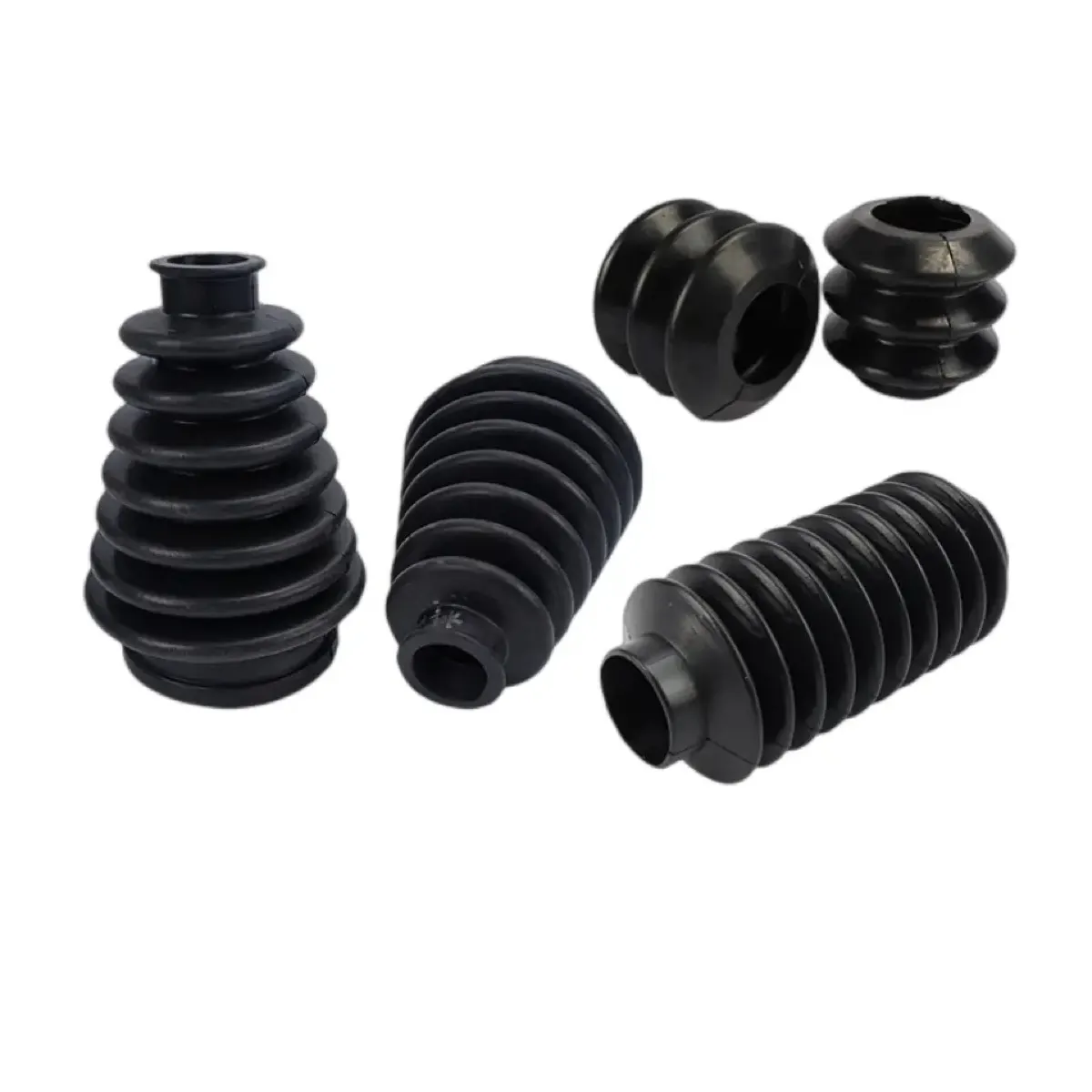
Round molded bellows for axial, lateral and angular movement in pipework and machinery — seamless wall, flanged, threaded or clamped ends, molded in EPDM, NBR, neoprene or silicone in Dongguan.
Circular rubber bellows are the default geometry we mold: a round sleeve with a series of concentric convolutions that fold and unfold as the line moves. Cylindrical symmetry keeps the reaction force even, so the load on pipe nozzles and supports stays axial and low — which is why circular bellows do most of the pipeline work.
How a Circular Bellows Behaves
Each convolution acts as a short spring element. More convolutions mean more stroke but a lower pressure rating; a thicker wall carries more pressure but flexes less. We balance the two against your three movements — axial extension and compression of roughly 20%-50% of nominal length, lateral offset and angular deflection — and against working pressure, media and temperature.
A circular bellows is integrally molded, so there is no weld at the convolution roots and no stress-corrosion path. The compound itself damps vibration instead of transmitting it. Ends are flanged, threaded or clamped to suit existing pipework, with reinforced rings at the connections where pressure and thrust concentrate.
Where Circular Bellows Fit
- Water, HVAC and district-heating pipework: thermal expansion and contraction
- Pump, compressor and chiller connections: vibration isolation without a rigid coupling
- Chemical and food process lines: compound matched to the media
- Round shafts, rods and actuators: the protective-cover version of the same geometry
- Retrofits where welded metal expansion joints have cracked or leaked
Material Choice
Compound
Serves
Temperature
Limit
EPDM
Hot water, steam, weathering
-40°C to 130°C
Oils and fuels
NBR
Oils, fuels, hydraulic media
-40°C to 130°C
Ozone and UV
Neoprene
Weathering, ozone, refrigerants
-40°C to 130°C
Steam and hot water
Silicone
High heat, food and medical
-60°C to 230°C
Tear and abrasion
All compounds are RoHS and REACH compliant; food-grade and medical-grade silicone are available on request.
What to Send for a Quotation
- Bore or inner diameter, plus overall installed length
- Axial, lateral and angular movement you need to absorb
- Working pressure, temperature and media
- End connection: flange standard, thread size or clamp band
- Available space and any bracket or anchor constraints
Quotations come back within 24 hours, tooling is quoted in 7 days, samples ship in 7-12 working days and tooling fees are refunded after the agreed volume.
FAQ
Circular or rectangular bellows — how do I choose?
Start from the opening you have to bridge. A round pipe or shaft calls for circular bellows; a rectangular duct or machine aperture calls for a rectangular mold, because forcing a round bellows onto a square flange concentrates stress in four corners.
How many convolutions does my bellows need?
The convolution count follows the largest movement you have to absorb at the pressure you run. Send the three movements and the pressure; we size the count, wall thickness and reinforcement together rather than guessing from bore alone.
Can you mold a replacement from a sample?
Yes. Send the sample or a drawing with the bore, length, convolution count and end details; we quote tooling in 7 days and return samples in 7-12 working days for fit and fatigue checks.